

At Rocket, we're constantly exploring ways to enhance our technological capabilities and improve team productivity. Today, I'm excited to share insights into one of our groundbreaking projects, where we’re accelerating the speed of development using AI.
The challenge of meeting productivity.
Meetings have long been a critical yet inefficient part of our work ecosystem. Traditionally, converting discussion points into actionable items was a time-consuming, manual process that could take days to complete. This project has been our revolutionary solution to this universal challenge.
What is this?
This is an initiative designed to be the ultimate post-meeting efficiency tool, beyond your generic AI meeting notes.
By leveraging conversational AI, we've created a system that captures every spoken word during calls and transforms them into:
- Detailed code update prompts
- Accurate Azure DevOps (ADO) stories
- Precise knowledge articles
- Comprehensive project updates
Real-world impact: From concept to code.
The original vision was to transform spoken code changes into executable reality.
During our initial trials, we discovered a high level of efficiency in software development and additional efficiencies, including Code Prompt Generation, ADO Work Item Creation, and many expanded use cases, including integrations with Rocket Navigator, our enterprise AI-powered conversational knowledge base.
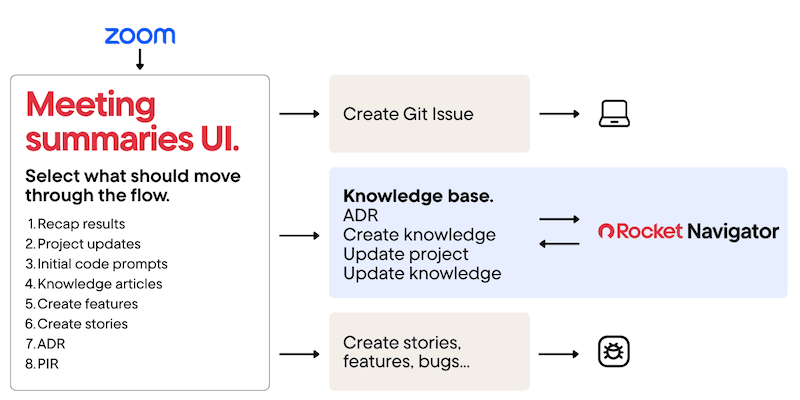
Conversational code generation.
When developers describe code changes during calls, mentioning specific lines of code, method names, and functionality, the system generates precise code prompts. These prompts are immediately suitable for GitHub Copilot or Claude to implement, often without a single keystroke being typed.
Once these prompts are created, we consume them into the Meeting Summaries UI and allow users to send them to Git as a Git Issue and assign Copilot to the change. Steps outlined below:
- Run post-meeting Zoom-generated code prompt.
- Create GitHub issue via Summary UI.
- Choose Repository to assign to.
- Assign the issue to Copilot and watch it work.
Automated story generation.
What previously consumed days of manual documentation can now be accomplished in minutes. Our system captures the nuances of technical discussions, generates comprehensive stories automatically, and maintains context during transcription.
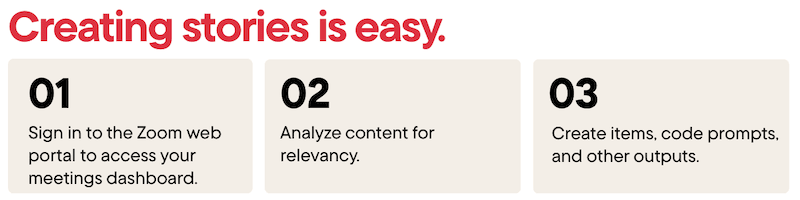
Expanded use cases.
Beyond code changes, we've successfully applied this to:
- Project updates
- Meeting recaps
- Post-incident reviews (PIR)
- Generating knowledge articles
- Creating and tracking tasks

Zoom integration: A game-changing partnership.
A key breakthrough in the project has been our integration with Zoom.
The Zoom SDK and AI admin interfaces provide flexibility and organization-level configurability, allowing us to:
- Configure prompts so they can be made available to everyone at Rocket.
- Standardize documentation styles such that we can look at documents created and immediately know where to find specific information (Zoom prompts allow us to customize and standardize our output).
By leveraging Zoom's configurable components, we've created a system that allows every meeting to be documented in a consistent, easily understood format, drawing from as well as contributing to a central knowledge base.

Human in the loop: Putting users in control.
At the core of this project is our commitment to human-centered AI. We've designed the system with a fundamental principle: technology should empower, not replace, human decision-making.
At the forefront of this technology is a user interface that allows our team members to select relevant information from meetings and choose what they want to do with it, as well as edit before sending into our ecosystem.
Key user-centric features:
1. Meeting privacy and control.
- All meeting content is initially available only to the meeting organizer.
- Organizers have complete discretion over sharing meeting notes, code prompts, and stories.
- Users choose which insights to act upon or distribute.
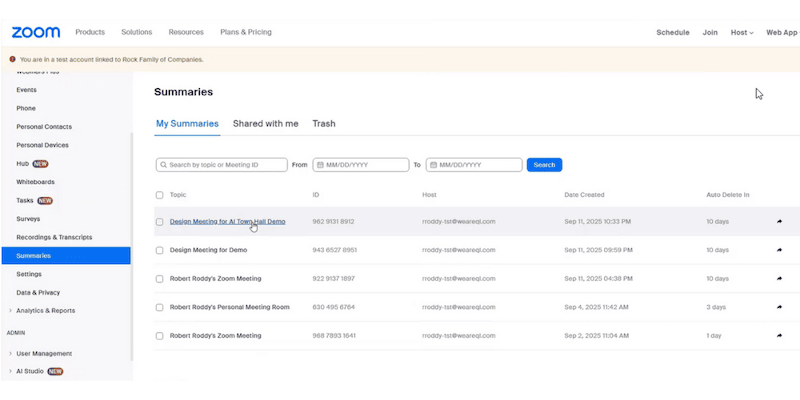
2. Intuitive post-meeting interface.
- Efficiently presents captured meeting information
- Allows granular control over knowledge sharing
- Enables users to: Update knowledge bases, create project updates, generate code prompts, and decide what content moves to different channels
This approach allows AI to serve as a powerful assistant, with humans making the final decisions about how information is used and shared.
Technical innovation.
This project leverages enterprise tools to maximize efficiency:
- Zoom AI Companion for meeting summaries
- Git for automated version-controlled artifact storage
- Azure DevOps for automated story and feature creation
- Claude for intelligent code prompt generation
Strategic vision.
This represents more than a technological solution. It's a paradigm shift in how we collaborate, innovate, and deliver value. By minimizing manual work and maximizing AI-driven insights, we're positioning ourselves at the forefront of organizational productivity.
What's next?
We'll continue refining our AI-driven workflows, and work on innovating in areas like:
- Highlighting potential synergies or conflicts between different team initiatives and suggesting cross-team collaboration opportunities
- Real-time compliance checking to help give guidance during brainstorming sessions
Stay tuned as we continue to push the boundaries of what's possible with conversational AI in the workplace.
Thank you to Robert Roddy, Tanner Haberl, and Justin Paterson for contributing.

Aaron Orshalick
Aaron Orshalick brings over 15 years of mortgage technology experience to Rocket Mortgage, where he's worked since 2014. His career spans multiple roles, including mortgage banker, analyst, data architect, software engineer, and team leader — all focused exclusively within the mortgage industry. A University of Texas at Dallas finance graduate, Aaron lives in the DFW area where he enjoys spending time with his wife and two kids, coaching their sports teams, and mountain biking local trails.
Related resources

5-minute read
8 ways to write more effective emails
Writing effective emails is easier said than done. With the average office worker receiving a flood of emails every day, knowing how to write ...
Read more

7-minute read
Sustainable AI: Balancing innovation and eco-responsibility
Explore the environmental impact of generative AI and discover practical strategies for using technology responsibly while minimizing carbon footprint and resou...
Read more

5-minute read
What 60 design students taught us about teaching AI
Rocket designers led a 2-day AI workshop at SCAD, teaching 60 students the prompting skills that work across every tool.
Read more